Software Development with AI
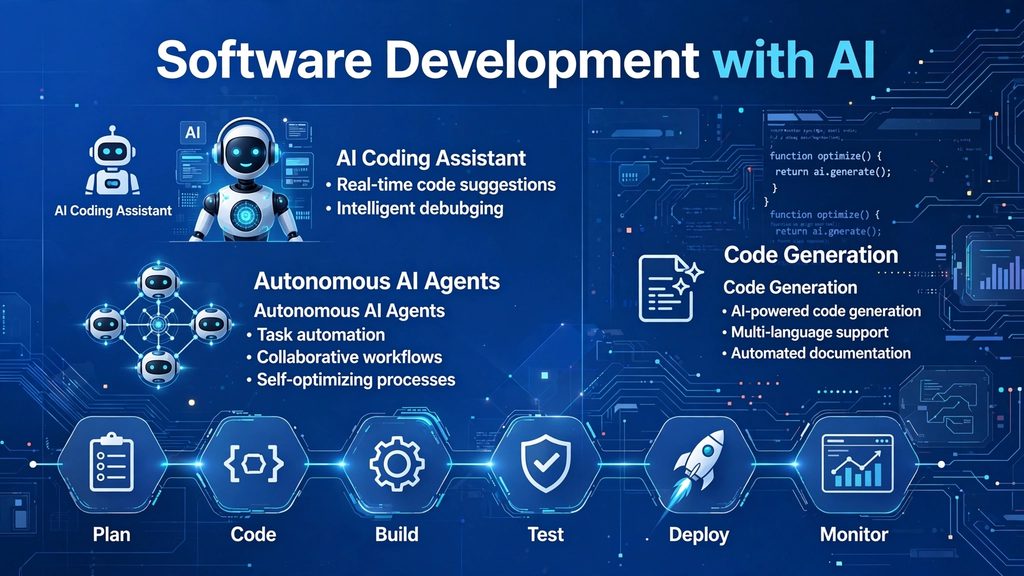
Artificial Intelligence has transformed software engineering from manual syntax construction into an intent-driven, augmented methodology. AI serves as an active co-pilot and autonomous agent across all phases of the Software Development Life Cycle (SDLC)—from requirements engineering to automated code synthesis, testing, security auditing, and continuous deployment.
AI Integration Across the SDLC phases are: Requirements & Design, Implementation, Testing & QA, Security & Code Review, and DevOps & Maintenance.
The integration of Large Language Models (LLMs) and generative tools into software development centers on four primary capabilities:
- Code Generation & Completion: Synthesizing boilerplate code, boilerplate patterns, and complex algorithms directly from natural language prompts or inline contextual commentary.
- Code Refactoring & Optimization: Automatically identifying anti-patterns, modernizing legacy codebases, and optimizing time/space complexity without altering functional semantics.
- Automated Bug Localization & Remediation: Analyzing stack traces and test failures to isolate root causes and suggest inline security patches.
- Documentation & Knowledge Synthesis: Producing inline docstrings, API documentation, and architecture decision records directly from underlying code semantics.
Modern AI-driven engineering is transitioning from simple inline tab-completion to Autonomous AI Software Agents
Programming for Cybersecurity
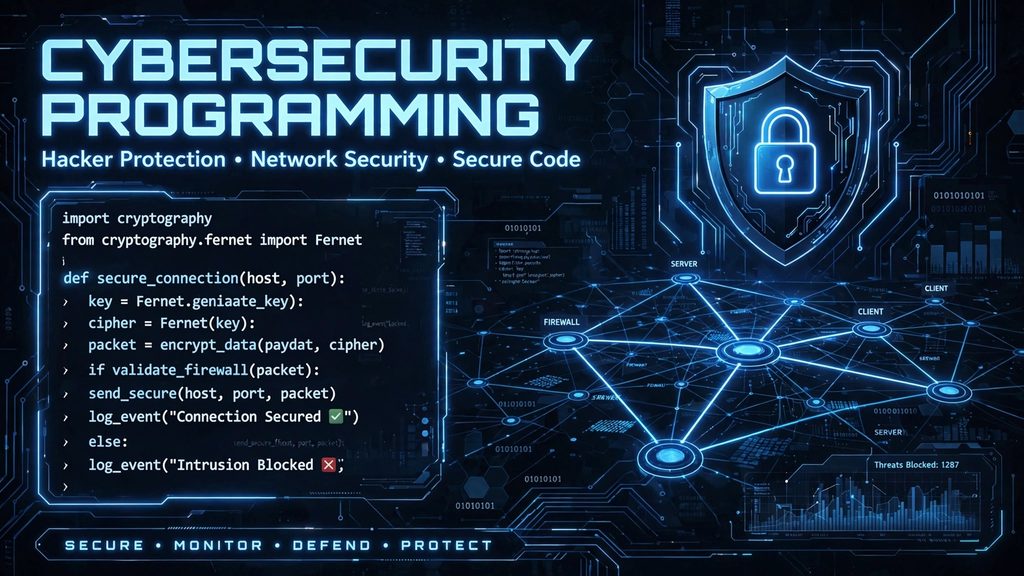
Python has emerged as the industry-standard language for cybersecurity practitioners due to its rapid development cycle, vast library ecosystem, and native support across Unix, Windows, and cloud environments. This document provides an overview of Python’s application across offensive, defensive, and research domains in cybersecurity.
1. Foundation of Cybersecurity
Understanding the basic building blocks of Python execution, environment setup, and data representation. Environment Setup & Execution which include: Installing Python, managing virtual environments (venv, Conda), writing scripts, and executing code via command line or IDEs (VS Code, Jupyter Notebooks). Variables, Data Types, & Operators – Declaring variables, dynamic typing, primitive data types (integers, floats, strings, booleans), and arithmetic/logical operators.
Basic Input/Output & Type Casting – Using print() and input() functions, formatting strings (f-strings), and converting between data types (int(), str(), float()). Directing the execution path of programs using conditional checks and iterative loops. Branching logic usingif, elif, and else statements, along with nested conditionals and truthy/falsy evaluations. Automating repetitive tasks using for loops (iterating over sequences, range()) and while loops, combined with control keywords like break, continue, and pass. Gracefully managing runtime errors using try, except, else, and finally blocks to prevent script crashes. Working with ordered collections: creating lists, indexing, slicing, mutable methods and immutable tuples. Writing concise, readable collection generators using list and dictionary comprehensions.
2. Offensive Security & Automation (Red Teaming)
Python is widely used by penetration testers and red teams to construct custom, lightweight tooling when off-the-shelf utilities are detected or restricted.
Key Capabilities & Frameworks
- Network & Port Scanning: Building asynchronous socket connections (socket, asyncio) to scan networks, discover open ports, and fingerprint service banners.
- Exploit Development & Prototyping: Utilizing pwntools for rapid buffer overflow creation, format string exploitation, and Remote Code Execution (RCE) payload delivery.
- Web Application Testing: Leveraging requests and BeautifulSoup to automate web vulnerability hunting (e.g., SQL injection fuzzing, cross-site scripting parameter discovery, and credential stuffing).
- Packet Crafting: Using Scapy to create custom TCP/IP packets, execute ARP spoofing, and simulate network attacks for security assessment.
3. Defensive Security & Threat Hunting (Blue Teaming)
Defensive security teams rely on Python to aggregate, parse, and analyze massive volumes of security data from disparate sources.
Key Capabilities & Frameworks
- Log Analysis & Event Parsing: Processing server and firewall logs (json, re, pandas) to identify anomalous authentication patterns or IOC (Indicator of Compromise) hits.
- SIEM & SOAR Integration: Interfacing via REST APIs with platforms like Splunk, Elastic, and Microsoft Sentinel to automate incident response workflows and isolate compromised endpoints.
- Threat Intelligence Ingestion: Pulling automated feeds from platforms like VirusTotal, AlienVault OTX, and MISP using standard Python wrappers (vt-py).
4. Malware Analysis & Forensics
Incident responders and reverse engineers use Python to automate repetitive forensic tasks and analyze malicious artifacts.
Key Capabilities & Frameworks
- Executable Inspection: Using pefile to parse Portable Executable (PE) headers, section characteristics, and imported/exported DLL functions in Windows binaries.
- YARA Rule Integration: Automating file scanning using yara-python to detect malware families across large file shares or disk dumps.
- Deobfuscation & Memory Extraction: Writing custom scripts to decrypt XOR-encoded payloads, unpack strings, and extract configuration details from memory dumps via Volatility 3.
5. Secure Coding & Devsecops
Python is central to modern DevSecOps pipelines, serving as the bridge between software development and continuous security enforcement.
Key Capabilities & Frameworks
- Static Analysis (SAST): Running tools like Bandit to automatically scan Python source code for security vulnerabilities (e.g., hardcoded credentials, insecure deserialization, eval() usage).
- Dependency Auditing: Utilizing pip-audit or custom scripts to verify third-party package hashes against known vulnerability databases (CVEs).
- Infrastructure as Code (IaC) Validation: Writing Python validation scripts to inspect AWS/Azure Terraform configurations and CloudFormation templates prior to deployment.
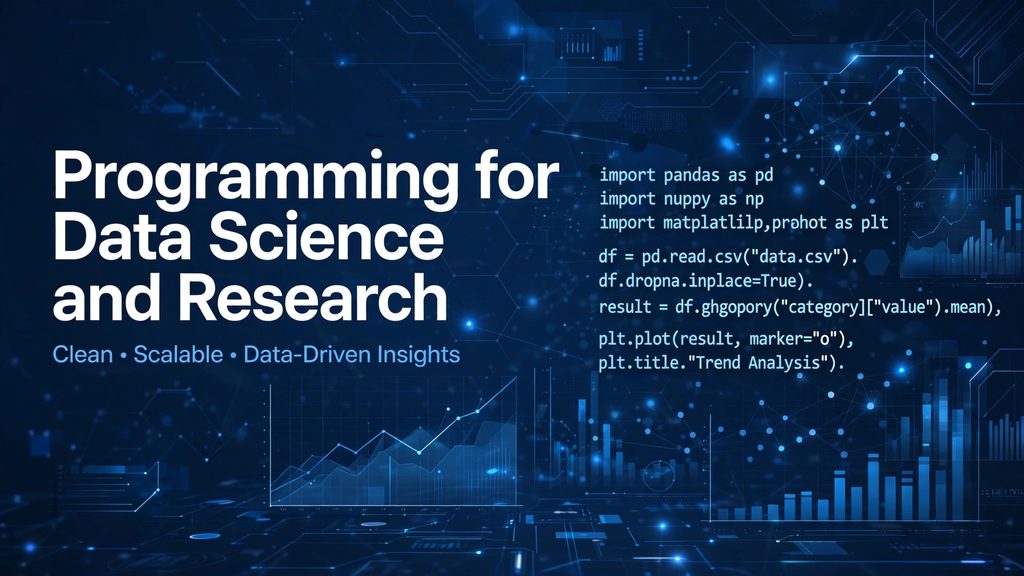
Programming for Data Science and Research
- Foundational Paradigm & Core Languages
- Python: Ecosystem overview (NumPy, Pandas, SciPy, Statsmodels, Scikit-learn, PyTorch/TensorFlow) and its dominance in data processing and machine learning.
- R: Statistical computing, spatial analysis, and advanced econometric modeling (tidyverse, lme4, forecast, ggplot2).
- SQL & Julia: Relational query optimization and high-performance numerical computing for heavy simulation tasks.
- Core Computational Workflows in Research
- Data Cleaning: Structuring messy observational datasets, handling missingness, and feature engineering.
- Exploratory Data Analysis (EDA) & Visualization: Measures of central tendency and measures of dispersion. Publication-ready plotting paradigms (matplotlib, seaborn, ggplot2).
- Inferential Statistics: Chi-square, T-test, Analysis of variance, Correlation.
- Statistical & Econometric Modeling: Parametric/non-parametric tests, Generalized Linear Models (GLMs), Quasi-Experimental Designs (such as Interrupted Time Series [ITS] and Difference-in-Differences [DiD]).
- Machine Learning & AI: Predictive modeling, cross-validation, and high-dimensional supervised/unsupervised learning.
- Reproducible Research & Best Practices
- Version control systems (Git/GitHub) for tracking empirical code and collaborative workflows.
- Literate programming tools (Jupyter Notebooks, Quarto, R Markdown) bridging code, equations, and prose.
- Virtual environments (Conda, Docker) ensuring computational reproducibility across operating system.